

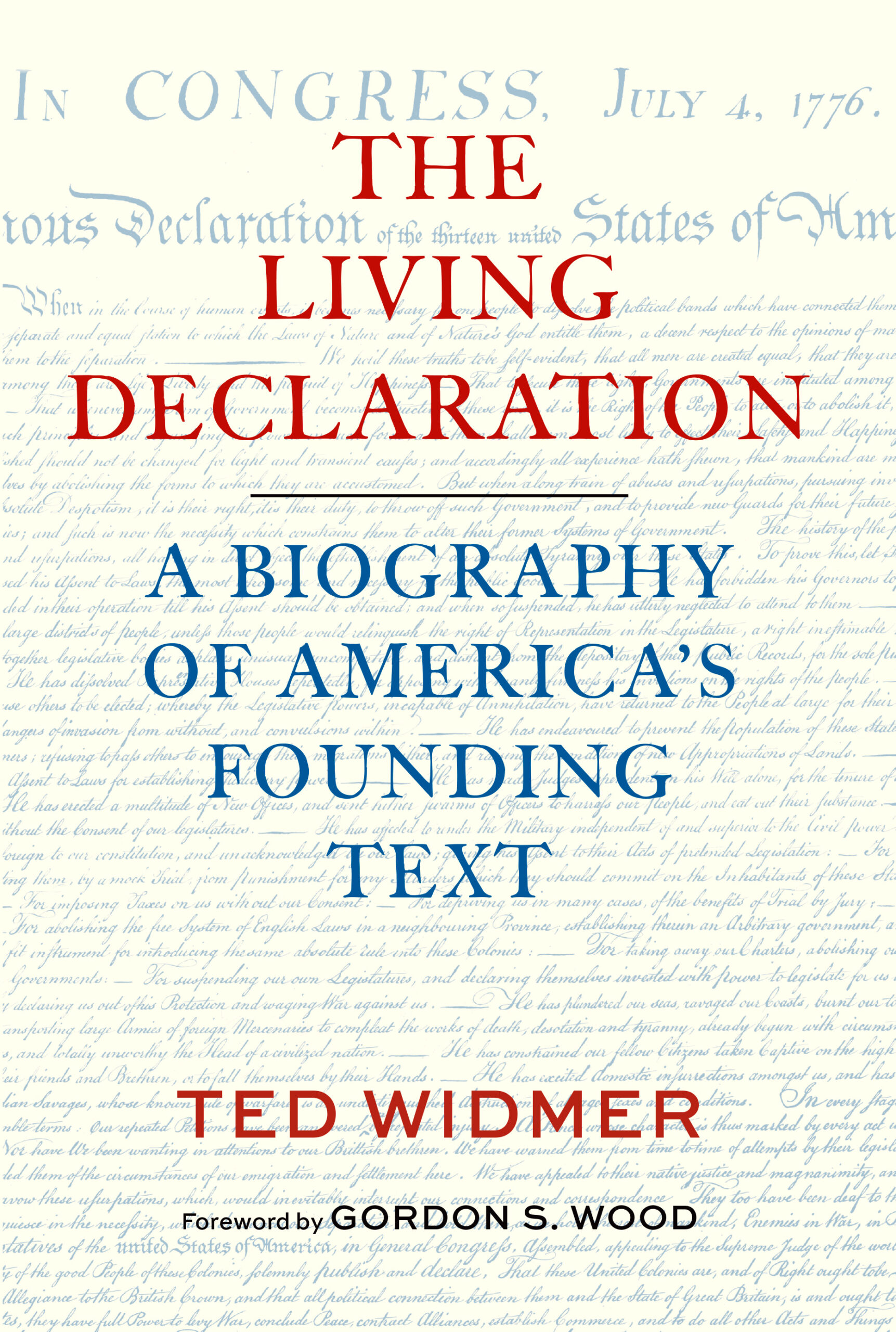
The Living Declaration with Ted Widmer
- Tue, Oct 13
Run Time: 75 min.
We hold these truths to be self-evident, that all men are created equal, that they are endowed by their Creator with certain unalienable Rights, that among these are Life, Liberty and the pursuit of Happiness.
250 years after they were written, these words remain at once familiar and startling. What do they mean to us today? Do we understand them in the same way the Founders did? Historian and former presidential speechwriter Ted Widmer seeks to answer these questions by returning to where the nation’s story began, the Declaration of Independence, to trace the remarkable history of how it came to be and how it has shaped the democratic aspirations of Americans and other peoples for more than two centuries.
Weaving together more than sixty fascinating original texts, in The Living Declaration, Widmer finds in the words of succeeding generations of Americans—radicals and conservatives, revolutionary insurgents and civil rights leaders, presidents and philosophers—the key to understanding the extraordinary durability of America’s founding ideas.
Moderated by Playhouse Founder John Farr.
Ranging from John Locke and Thomas Jefferson to Frederick Douglass and Abraham Lincoln, from Emma Goldman and Huey Long to H. L. Mencken and Ho Chi Minh, and from Martin Luther King, Jr., and Hannah Arendt to Ronald Reagan and Barack Obama, the voices gathered here are impassioned and often disagree. Still, they are united in the belief that the Declaration has something crucial to tell us about the American people and the larger struggle for human freedom. “They speak to us,” Widmer writes, “and they talk to each other as well, in a conversation that will never end.”

Ted Widmer is a prize-winning historian who has written or edited a dozen books, including Lincoln on the Verge: Thirteen Days to Washington, and the two-volume Library of America edition, American Speeches. He writes frequently for The New Yorker, The Guardian, The Boston Globe, and The New York Times, where he helped create the Disunion feature about the Civil War.